
Modern spinning mills depend on rotating machinery running continuously and reliably. Bearings are among the most critical components — and abnormal vibration is often the first sign that something needs attention. The problem is that most maintenance teams have no way to detect this change before it becomes a breakdown.
MOH-AI SpinGuard V0.1 is our first step toward changing that — an AI-assisted vibration analysis platform built to help maintenance teams detect abnormal bearing vibration, investigate fault patterns, and establish machine-specific baselines.
Rather than claiming to predict exact failure times, SpinGuard focuses on a more honest and practical question:
"Is this machine behaving differently from its normal operating condition?"
From Laboratory Data to Industrial Validation
SpinGuard V0.1 was developed and evaluated using the HUST Bearing Dataset — a publicly available benchmark containing 99 recordings across multiple bearing types, loads, and fault conditions.
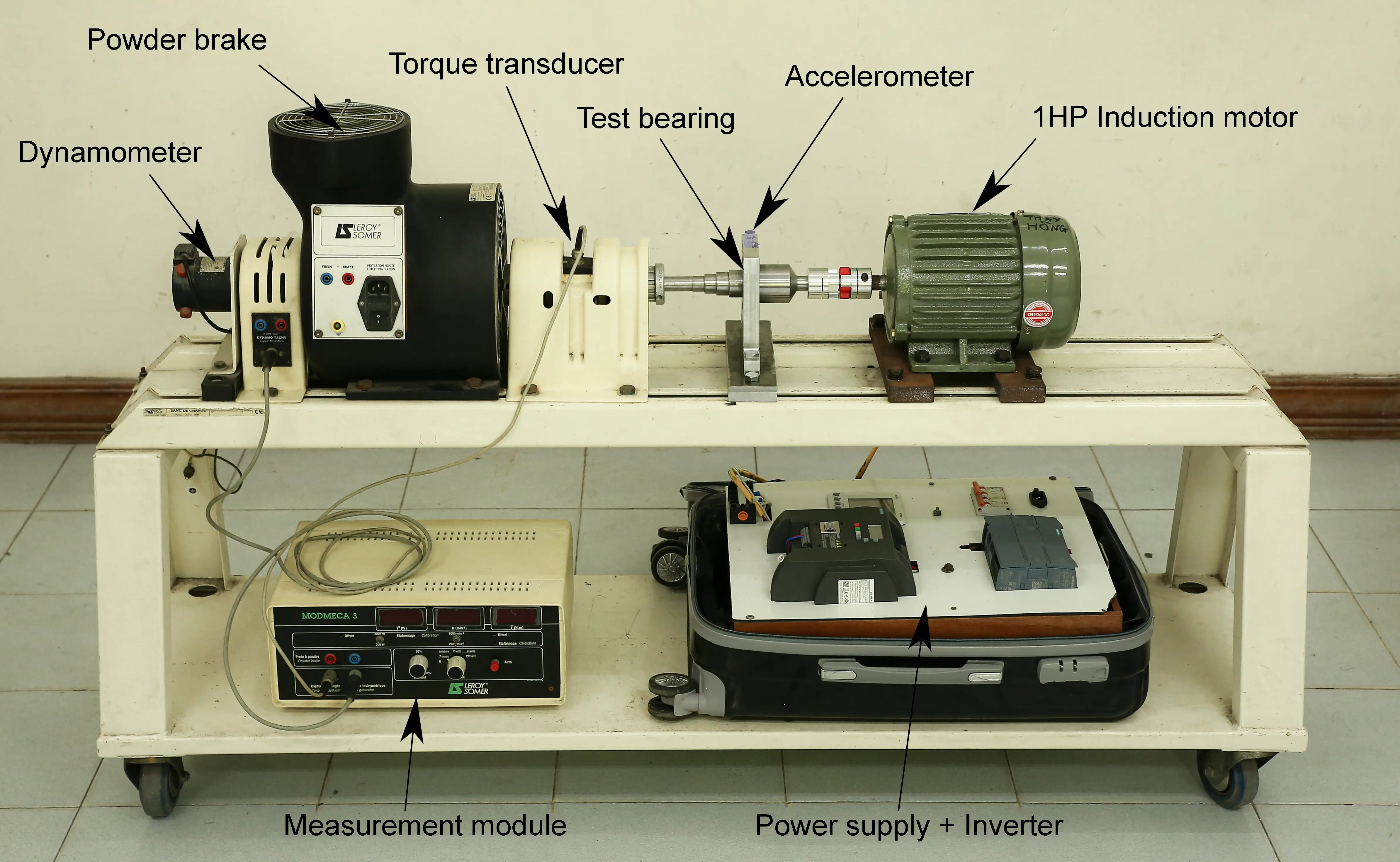
A typical setup: accelerometer mounted at the bearing housing to capture vibration signals.
The laboratory pipeline processes high-frequency vibration signals through a structured sequence:
The system extracts both statistical and frequency-domain characteristics from each vibration segment:
- RMS vibration, Kurtosis, Peak & Crest factor — statistical time-domain indicators
- Spectral centroid, bandwidth & total energy — frequency composition of the signal
- BPFI, BPFO, BSF, FTF — bearing defect frequency indicators tied to geometry
What the Model Validation Actually Showed
During development, we evaluated both binary anomaly detection and multi-class fault diagnosis. The results revealed an important engineering insight that shaped the entire product philosophy.

Vibration analysis across multiple axes (X, Y, Z) showing FFT frequency data at ~1497 RPM.
Detecting "normal vs abnormal" vibration is substantially more transferable than identifying the exact fault type on an unseen bearing design.
Our cross-bearing validation showed:
- The simple RMS-based anomaly detector achieved a 99.1% Macro F1 across previously unseen bearing sizes in the HUST benchmark.
- The multi-class XGBoost fault classifier achieved approximately 41% Macro F1 when asked to identify specific fault types on completely unseen bearing models.
Instead of hiding this limitation, we incorporated it into the product architecture. When SpinGuard encounters an unsupported bearing, it does not invent a fault classification. It reports:
"Abnormal vibration detected — specific fault not confirmed."
This makes SpinGuard far more suitable for responsible industrial deployment than black-box solutions that confidently report fake fault types.
Machine-Specific Baseline Calibration
Laboratory datasets are useful for developing algorithms, but real factories introduce additional variables: machine-to-machine differences, sensor mounting, speed variations, load changes, structural vibration, and ambient industrial noise.
Therefore, SpinGuard V0.1 includes a Machine-Specific Baseline Calibration System. Instead of assuming every machine has the same vibration level, SpinGuard learns what normal looks like for each individual machine.
Normal recordings during stable operation
Calculate statistical distribution of normal
Set thresholds from baseline deviation
Compare new readings to baseline
Flag significant deviations as elevated risk
Risk Levels: Plain Language for Maintenance Teams
SpinGuard classifies each measurement into one of three operational states using Z-score statistical comparison against the established baseline:
No significant deviation detected from the calibrated baseline.
One or more vibration indicators have significantly deviated from the baseline. Inspection recommended.
A reliable baseline has not yet been established. SpinGuard will not present false certainty.
The SpinGuard Architecture
At the engineering level, SpinGuard combines a modular, production-ready stack:
The system supports MAT, CSV, and Excel (.xlsx/.xls) data formats, making it compatible with most industrial data acquisition systems immediately. Users can configure the vibration column, sampling frequency, and RPM — and SpinGuard dynamically calculates shaft frequency to adapt to different machine operating speeds.
Designed With Scientific Honesty
One of the core principles behind SpinGuard is simple: if the model does not have enough evidence, it should say so.
SpinGuard V0.1 does not claim exact bearing remaining life, "failure in 24–72 hours," guaranteed downtime reduction, or universal diagnosis across every bearing. It separates anomaly detection from fault diagnosis and explicitly identifies unsupported conditions.
The objective is to assist maintenance teams, not replace engineering judgment.
What Comes Next?
The next stage is no longer about benchmark scores. It is about real-world validation with real spinning machine data from industrial environments. The pilot process will answer the questions that laboratory datasets cannot: how stable is the baseline over time? How does machine load affect vibration? Which fault patterns can be reliably diagnosed across different machines?
MOH-AI Tech is actively seeking textile mill and industrial equipment partners who want to participate in the SpinGuard industrial pilot program. If your facility has spinning machines and an interest in data-driven maintenance, we would love to talk.